About the Journal
Policies
- Aims and Scope
- Publisher
- Open access policy
- Creative Commons license
- Copyright
- Peer review policy
- Plagiarism detection
- Storage and digital preservation
- Ethical code and good practices
- Conflict of interest
- Editorial inbreeding
- Audience of the journal
- Journal funding sources
- Review and publishing times
- Interoperability Protocol
- Journal statistics
Submission
- Types of contribution
- Publication frequency
- Peer review process
- Submission formats and components
- Submission costs
_______________________________________________________________________________________________________________________________
AIMS AND OBJECTIVES
Informática y Sistemas (IyS), e-ISSN 2550-6730, is a peer-reviewed, open access scientific journal published by Universidad Técnica de Manabí (Portoviejo, Ecuador). The journal publishes original research articles, review articles, and methodological articles, evaluated through double-blind peer review with reviewers external to UTM.
Subject areas: The journal covers the following areas of information and communication technologies:
- Software engineering and information systems
- Computer networks and telecommunications
- Computer science and algorithms
- Artificial intelligence, machine learning, and data science
- Information security and cybersecurity
- Emerging technologies: Internet of Things (IoT), cloud computing, big data
- Information and communication technologies applied to education
- Human-computer interaction and usability
- Technological devices and embedded systems
Languages: The journal accepts manuscripts in Spanish and English.
Fees: The journal does not charge article processing charges (APC), submission fees, or publication fees.
_______________________________________________________________________________________________________________________________
Publisher
Informática y Sistemas is published by Universidad Técnica de Manabí (UTM), through its Editorial Processes Unit, affiliated with the Research Department and the Academic Vice-Rectorate.
Publisher’s mailing address: Universidad Técnica de Manabí Av. Urbina y Che Guevara Portoviejo, Manabí, Ecuador Postal Code: 130105
Publisher’s institutional website: https://www.utm.edu.ec
Editorial Processes Unit: https://utm.edu.ec/editoriales_utm
UTM Journals Portal: https://revistas.utm.edu.ec
Editorial contact: revista.iys@utm.edu.ec
Editor-in-Chief: Ph.D. Jorge Párraga Álava (jorge.parraga@utm.edu.ec)
_______________________________________________________________________________________________________________________________
OPEN ACCESS POLICY
Informática y Sistemas is an open access journal. All published content is freely and immediately available, without subscription or registration barriers, to all users. Readers may read, download, copy, distribute, and print the full text of articles under the terms of the Creative Commons CC BY-NC-ND 4.0 license, which permits non-commercial use and redistribution without modifications, provided appropriate credit is given to the authors.
The journal does not charge authors any article processing charges (APC), submission fees, or publication fees.
_______________________________________________________________________________________________________________________________
LICENSE
All content of the journal is under the Creative Commons International License CC BY-NC-ND 4.0. Creative Commons Attribution-NonCommercial-NoDerivatives 4.0 International License.

_______________________________________________________________________________________________________________________________
COPYRIGHT
IyS declares that the content of contributions is the sole responsibility of the authors, who retain their copyright, and in no way the responsibility of the journal or the entities for which the authors work.
_______________________________________________________________________________________________________________________________
PEER REVIEW POLICY
Informática y Sistemas employs a double-blind peer review process for the evaluation of all submitted manuscripts. Reviewers are external to Universidad Técnica de Manabí and are experts in the manuscript’s subject area. The review process consists of two phases:
Phase 1: Editorial pre-screening. The Editorial Board verifies compliance with formal requirements (format, thematic scope, originality, and acceptable similarity levels as determined by plagiarism detection).
Phase 2: Peer review. Manuscripts that pass pre-screening are sent anonymously to two independent external reviewers. In case of disagreement, a third reviewer is consulted. Evaluation criteria are publicly available on this platform. The final decision on acceptance or rejection is based on reasoned reviewer reports and is formally communicated to authors.
The Editor-in-Chief ensures the selection of qualified and specialized reviewers to guarantee an objective, balanced, and unbiased evaluation.
_______________________________________________________________________________________________________________________________
PLAGIARISM DETECTION
The Editorial Committee of IyS is responsible for identifying the levels and percentages of similarity in texts submitted for publication consideration, compared to information available in open access. Therefore, before the peer review process, submissions undergo a plagiarism analysis using the Compilatio anti-plagiarism system. The editor ensures that the article has not been previously published, that the content is original, and that the intellectual property of other authors has been correctly referenced. Articles exceeding 10% similarity may be rejected or returned to the authors for correction.
_______________________________________________________________________________________________________________________________
STORAGE AND DIGITAL PRESERVATION
Informática y Sistemas is committed to the long-term preservation of its published content. The journal implements the following digital preservation strategies:
LOCKSS / CLOCKSS: The Open Journal Systems (OJS) platform used by the journal is compatible with LOCKSS (Lots of Copies Keep Stuff Safe) and CLOCKSS (Controlled Lots of Copies Keep Stuff Safe) services, enabling distributed content preservation across participating libraries.
Internet Archive: Articles from each issue are additionally stored in Internet Archive (https://archive.org) in PDF format, providing permanent public access.
Institutional repository: Content is also preserved in the institutional repository of Universidad Técnica de Manabí.
The magazine undertakes not to use the personal data of users registered on the platform for any purpose other than those specified therein, nor to disclose such data to third parties.
_______________________________________________________________________________________________________________________________
ETHICAL CODE AND GOOD PRACTICES
Informática y Sistemas adheres to international standards of ethics in scholarly publishing. The journal follows the guidelines established by the following organizations:
Committee on Publication Ethics (COPE)
The journal is committed to complying with COPE Core Practices in all aspects of the editorial process, including authorship management, peer review, conflicts of interest, retractions, and post-publication corrections https://publicationethics.org/core-practices
Open Access Scholarly Publishing Association (OASPA)
The journal adheres to the Principles of Transparency and Best Practice in Scholarly Publishing https://oaspa.org/principles-of-transparency-and-best-practice-in-scholarly-publishing/
Declaration of Helsinki
For studies involving human subjects, authors must ensure compliance with the ethical principles of the Declaration of Helsinki.
By submitting a manuscript, authors, reviewers, and editors accept the ethical guidelines described below.
Editorial Team
All participants in the editorial process undertake to maintain complete confidentiality about the manuscripts received, their authors and the topics covered. Furthermore, the editors will ensure that decisions are based exclusively on technical considerations, quality and originality of the study, as well as respect for the accepted rules of scientific writing. The editorial team will select reviewers with extensive experience in the subject matter of the journal to guarantee a critical evaluation of the contents and will ensure the originality, clarity, relevance and contribution of the study to the editorial line. The confidentiality of article data and personal information of authors and reviewers will be maintained, rigorous and transparent evaluations will be carried out according to the established refereeing process, and the anonymity of authors and reviewers will be guaranteed during the peer review process. Furthermore, authors will be informed about the status of their article during the review process and the established deadlines will be respected. The editorial team undertakes not to use the contents of articles received in the journal for its own research without the written consent of the author.
In their role as the journal's top officials, the editorial committee of Informática y Sistemas commits to:
- Join efforts to meet the needs of both readers and authors.
- Work towards the continuous improvement of the journal.
- Ensure the quality of published material.
- Guard the integrity of the scientific production published in the journal.
- Safeguard freedom of expression.
- Preserve the academic integrity of the content.
- Prevent commercial interests from compromising intellectual standards.
- Make corrections, clarifications, retractions, and apologies after publication if necessary.
- Protect intellectual property and copyright.
- Ensure the editorial process is rigorous and clear.
- Specify to authors the peer review and evaluation processes, as well as the procedures and requirements, access conditions to the journal, and possibilities of using different articles within the framework of copyright.
- Promptly and sufficiently resolve any concerns raised by those involved in the editorial process.
- Decisions to accept or reject an article for publication should be based on the importance, originality, and clarity of the article, as well as the validity of the study and its alignment with the journal's mission. Therefore, the editorial team of Informática y Sistemas guarantees quality and objectivity in the peer review and evaluation processes, as well as throughout the editorial process, respecting commonly accepted rules of scientific writing.
Reviewers
Informática y Sistemas provides reviewers with an online form detailing manuscript evaluation parameters while preserving the confidentiality of their identity. Reviewers are responsible for:
- Evaluating if an article is suitable for publication, documenting it in the Article Evaluation Form, and providing comments on the original document.
- Justifying decisions with solid reasons, especially when rejecting an article, detailing the evaluation in each aspect requested by the journal.
- Impartially evaluating the article, recognizing different perspectives without automatically disapproving, and conducting a rigorous assessment based on science, originality, and relevance of information.
- Accepting only those texts for which they have the necessary competence.
- Meeting agreed-upon deadlines with the journal for submitting evaluations through the provided evaluation protocol.
- Declare and disclose any conflicts of interest that may influence their ability to impartially review the text, whether of a personal, financial, intellectual, professional, political or religious nature, and to report to the editor any suspected irregularities in the evaluated text.
- Providing respectful and constructive comments resulting from the article evaluation.
- Supplying the data required by the journal in the OJS system.
Authors
As a fundamental principle, all authors must assume formal and public responsibility for all content in their article. They should be willing to provide any additional information the journal may require to address doubts or concerns during the review process. Additionally, it is necessary to disclose individual contributions, clearly indicating each author's involvement in the conception, design, analysis, writing, and any other activity directly related to the study. If there is no specific task attributable to an author, that author should not be credited or included in the document. In no case will honorary authorship be accepted by the journal. To establish authorship in scientific works, an author is understood as someone who:
- Participated in formulating the problem and hypothesis.
- Conceptualized, created, thought, studied, reviewed, analyzed, or interpreted the data.
- Participated in the creative development of the manuscript or in the editing of statistical analysis.
- Played a significant role in the final version of the work or wrote a substantial part of the text.
- Participated in the interpretation of the results.
- Is the principal investigator of the research project and has conceived the central idea of the entire manuscript.
- Has the ability to explain and defend parts of the work or study in public or academic settings (CNRSI, 2008).
Those who do not meet any of these criteria may appear as collaborators in the acknowledgments but never as authors of the manuscript. Lastly, under no circumstances will the submission of a manuscript be accepted without the permission of at least one of the authors.
Authors are responsible for:
- Ensuring the submitted article is original and unpublished, undergoing analysis through the Compilatio anti-plagiarism system.
- Acknowledging that authors retain their authorship rights, not transferred to the journal or entities for which the authors work in any way.
- Providing complete information, including name, surname, institution, city, province, country, email, and ORCID identifier.
- Avoiding the submission of previously published manuscripts, considering situations such as full prior publication, inclusion of extensive fragments of previously published material, or the presentation of works that are part of extensively published proceedings. These criteria apply to publications in any format (print or electronic) and in any language.
- Disclose any conflicts of interest, financial or otherwise, that may influence the results or interpretation of their work, including sources of research funding. In addition, avoid conflicts of interest in the publication of data and research results.
- Citing and referencing clearly any excerpt taken from another author's work or the author's own texts, including data sources, tables, figures, and documents.
- Refraining from submitting the article to another journal while it is under review in Informática y Sistemas. Detection of this behavior will result in the suspension of the corresponding review or publication process.
- Accepting and adhering to the editorial standards, criteria, and procedures established by Informática y Sistemas.
- Ensuring all studies on humans or animals comply with national, local, and institutional laws and requirements. If necessary, provide details on how compliance with the ethical principles of the Declaration of Helsinki and the NIH policy for the use of laboratory animals was ensured. For studies on humans with specific forms, obtain written informed consent and protect the privacy of participants.
Policies on Unethical Practices
In general, those involved in the process of publishing articles in Informática y Sistemas commit to maintaining honest conduct, with professional technical practice and in good faith, always considering that the process and results reflect ethical work.
Those involved in the editorial process commit, to the extent of their abilities and responsibilities, to follow up on any complaint or suspicion of scientific malpractice, reserving the right to take measures they consider appropriate in cases where a lack of ethics is verified in any work submitted for evaluation.
Faced with unethical behavior, the first decision will be made by the Chief Editor, who will analyze the issue and reject any document that includes inappropriate conduct or practices. If the problem or situation is more severe, the Chief Editor may first seek advice from the Editorial Committee and then from the Editorial UTM Publications Committee.
Some examples of these unethical practices may include:
- Plagiarism: identified as the violation of copyright and intellectual property, punishable by law.
- Self-plagiarism: an author is considered to self-plagiarize when reusing their own material that has already been published without indicating the reference to the previous work.
- Inappropriate use of quotations, such as excessive inclusion of irrelevant or journal-related quotations, unjustified self-citations and alteration of words that may distort the original meaning of a quotation.
- Copying elements of another author's work (text, illustrations, graphics, formulas) that are not properly referenced according to international citation standards.
- Incorrect application of citation when taking fragments of texts from another author.
- Reuse of content from an author that has been previously published.
- Redundant or duplicate publication: the simultaneous or multiple submission of the same article to different journals.
Handling of Complaints and/or Appeals
In Informátic y Sistemas, it is ensured that authors, reviewers, and readers have the right to file complaints related to the journal. Particularly for authors, they are granted the full right to appeal editorial and review decisions. All complaints will be handled based on facts; therefore, the author must exclusively argue their case on that basis. The Editorial Team commits to conducting a thorough and fair analysis of all reasons, facts, and evidence presented.
To file a complaint or appeal, the concerned party must send an email to revista.iys@utm.edu.ec, addressed to the Editor-in-Chief of the journal. The communication must:
- Formally confirm that all guidelines and procedures provided by the journal have been read, understood, and followed without exception.
- Clearly, specifically, and unequivocally indicate the nature of the complaint.
- Present in an organized and detailed manner all the facts supporting the case.
- Attach all documents supporting the reasons and facts stated in the complaint.
- Formally acknowledge the acceptance of the journal's decision as final once the defined procedure is concluded.
Upon receipt of the complaint, the Editorial Team will follow the following procedure:
- Within 7 business days after reception, an acknowledgment of receipt of the complaint will be sent to the complainant.
- Within 20 business days following acknowledgment, the Editorial Team will analyze the complaint, the supporting facts, and the presented documents. A preliminary response will be sent to the complainant.
- The complainant will have 7 business days to respond, either accepting or challenging the preliminary decision.
- In case of challenge, additional justifications and evidence must be provided. If no formal response is received, the decision will be considered final, and the Editorial Team will take necessary actions as per the issued communication. If the preliminary decision of the Editorial Team is formally challenged, a special committee of specialists and peers will be established to analyze the case.
- The Editorial Team's decision will be issued within 20 business days and considered final, to be executed as soon as possible after communication to the concerned parties.
Post-publication correction and retraction
To request post-publication corrections or retractions, authors should take the following steps:
- Carefully identify and document errors or ethical problems in their published work.
- Once identified, authors should contact the Editor-in-Chief directly at revista.iys@utm.edu.ec, providing a detailed description of the problem and any relevant evidence.
- Authors should provide any additional information that may be required and respond in a timely manner to the Editor-in-Chief's requests.
By following these steps and working closely with the journal, authors can make a significant contribution to ensuring the integrity and accuracy of their work.
_______________________________________________________________________________________________________________________________
CONFLICT OF INTERESTS
Conflicts of interest are all situations that could exert undue influence on the submission, review or publication of a manuscript. These conflicts may be financial, academic or professional, contractual or personal, or of any other nature not explicitly stated.
All persons involved in the processing of a manuscript must declare any potential conflicts of interest that may interfere with the objectivity or integrity of a publication. This includes authors who submit a manuscript, reviewers who are asked to evaluate a manuscript, and editors who handle the manuscript.
This declaration should be made at the time of submission of the manuscript, in the case of authors, or as soon as the manuscript is received for handling or review, in the case of editors and reviewers.
Authors and reviewers must affirm that, during the two years following submission of the article, they have no actual or potential conflicts, whether financial, personal or otherwise, that could adversely affect the integrity of the article.
_______________________________________________________________________________________________________________________________
EDITORIAL INBREEDING
The Editorial board constantly downplays inbreeding practices. The proportion of published articles, in which at least one of the authors is either editor, editorial board member or reviewer, does not exceed 20% in the last two issues published.
_______________________________________________________________________________________________________________________________
AUDIENCE OF THE JOURNAL
nformática y Sistemas is aimed at researchers, university faculty, bachelors and graduate students (master’s and doctoral level), technology professionals, and members of the international scientific community with interest in the fields of computer science, information systems, and communication technologies. The academic level of published content is appropriate for a graduate and research audience.
_______________________________________________________________________________________________________________________________
JOURNAL FUNDING SOURCES
Informática y Sistemas is entirely funded by the institutional budget of Universidad Técnica de Manabí, through its Editorial Processes Unit. The journal does not receive external funding from commercial, advertising, or organizations with interests in published content. No fees are charged to authors.
Authors are encouraged to acknowledge the funding sources of their research in their articles, when applicable.
_______________________________________________________________________________________________________________________________
TYPES OF CONTRIBUTIONS
The journal accepts manuscripts are not simultaneously postulated in other journals. The manuscripts must make a rigorous and interesting analysis on a specific scientific topic of common interest to researchers and professionals. Articles may have figures, pictures, diagrams, tables, or charts. The classification given by the standards of the American Psychological Association (APA) 7th (seventh) edition is used to consider the types of articles, which is explained below:
a) Original scientific manuscripts
These are the manuscripts with the highest priority for scientific publication in the journal. These refer to authentic and original investigative reports, they must include analyzes that demonstrate the verification of the hypothesis and generate new and diverse results not contained in other publications. This type of article will replicate the entire procedure of the research. The text must be well structured, divided into logically ordered sections or paragraphs to facilitate its understanding..
b) Review manuscripts
These are manuscripts in which a critical evaluation of previously published research is carried out. A definition and clarification of the problem must appear in its development, as well as a synthesis of the investigations carried out previously, which will allow reporting on the status of the investigation to be carried out. The author will reflect the common points of opinion and contradictions that he has found regarding the reviewed literature and will make suggestions of the steps that he proposes to follow to solve the detected problem. These articles consider in their structure the description of the bibliography search methods. It is very important that updated bibliography of the subject is used, no less than 20 studies, in which at least 70% date from the last 5 years. Seriousness and rigor are required in the selection of the information exposed. It must clearly explain the purpose of the review, the sources and databases consulted, the search strategy; the criteria for the selection of the studies.
c) Methodological manuscripts
These articles address a new methodological approach or modifications to research methods proposed previously. They should provide researchers with data that allows them to apply the new methodology proposed. They have the characteristic of allowing comparison between methods. It is important to note that these articles should be presented as appendices and/or supplementary material.
_______________________________________________________________________________________________________________________________
PUBLICATION FREQUENCY
Informática y Sistemas publishes one volume per year consisting of two semiannual issues:
Issue 1: January to June (published in July)
Issue 2: July to December (published in December)
The journal follows a continuous publication model within each issue: articles are published online individually as they complete the editorial process, with DOI assignment making them immediately citable. Manuscript submissions are accepted year-round.
Additionally, the journal may publish thematic special issues coordinated by guest editors, subject to the same peer review standards.
_______________________________________________________________________________________________________________________________
ARTICLE REVIEW PROCESS
Article submissions should be made through our Open Journal Systems (OJS) platform. It is necessary to register, including the ORCID identifier, and log in to submit article proposals following the editorial guidelines established by the journal and to check the status of current submissions.
Review Process
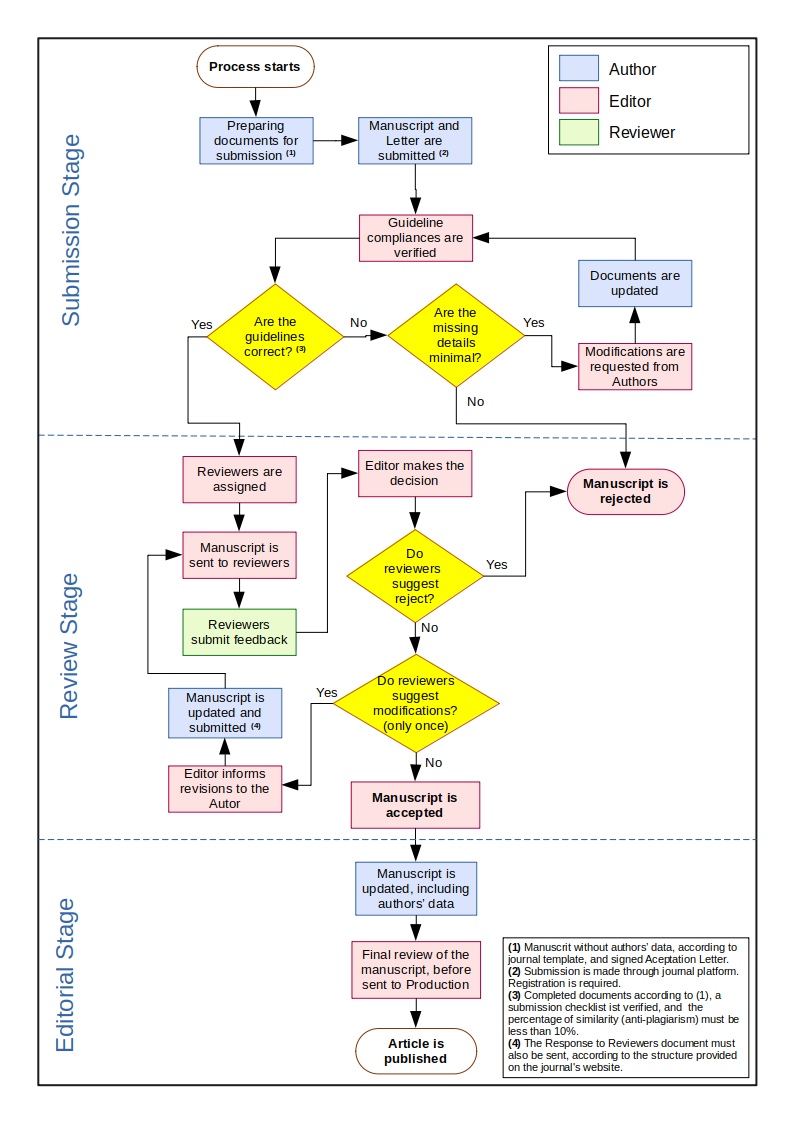
IyS is a peer-reviewed journal that employs blind review by anonymous academic peers external to the Technical University of Manabí for article approval, following a rigorous procedure outlined below:
1) Through the Open Journal Systems (OJS), submissions (articles without author information), a letter of acceptance of the publication guidelines (signed by the corresponding author), and a checklist of requirements (in the proposed format) are received.
2) Submissions are examined by the Editorial Board to verify compliance with the journal's editorial guidelines and preliminary evaluation requirements as a scientific publication. Articles meeting the aforementioned requirements proceed with the editorial process, while those that do not comply are notified and the editorial process is terminated.
3) Articles that pass the preliminary evaluation undergo a plagiarism check to identify any content similarities with other works. This is done using the Compilatio anti-plagiarism system, where the editor ensures that the article has not been previously published, that the content is original, and that the intellectual property of other authors has been correctly referenced. Articles passing the plagiarism check (maximum 10% similarity) continue with the editorial process.
4) Submissions are anonymously reviewed by two expert academic peers in the article's thematic areas. During the editing process, authors may be consulted if difficulties arise, and clarifications may be necessary through (up to) two rounds of review.
5) Upon receiving the review results from academic peers, the Editorial Board formally communicates the response to the authors. If deemed necessary, authors may revise the text and resubmit it within a maximum period of 15 days from the notification for further review. Failure to receive a response from the authors within the specified period may result in the Editorial Board definitively rejecting the work. If an article is not accepted for evaluation but the topic is relevant to the journal, authors are invited to make the necessary modifications for resubmission.
Evaluation Criteria (Reviewer Form - Round 1)
1. Evaluation
In this section, the reviewer provides a brief synopsis of the article and then highlights its main contributions, novelty, or other aspects deemed relevant.
2. Comments
In this section, the reviewer provides detailed comments on each aspect they believe the author should modify, explain, or remove. Considerations include: Does the introduction adequately argue the relevance of the work and clearly establish its contribution based on literature review? In the case of experiments, have the materials and methods been adequately described? Have the results been presented clearly and concisely, and does their discussion facilitate understanding of the research results?
3. Novelty of the article
- Excellent
- Good
- Regular
- Insufficient
4. Technical content
- Excellent
- Good
- Regular
- Insufficient
5. Quality of article presentation
- Excellent
- Good
- Regular
- Insufficient
Evaluation Criteria (Reviewer Form - Round 2)
1. Verification of requested changes
In this section, the reviewer is requested to provide detailed feedback on each aspect they considered necessary to correct during the previous round of review. They should indicate whether the review suggestions have been incorporated or not. If necessary, attach the original manuscript indicating the changes not made. The author(s) may have justified why they did not adopt the suggestions. In that case, indicate whether you agree or disagree with the given justification.
Reviewer Decision
Based on the results of the article evaluations, the following response criteria are considered for each submission:
- Accept this submission: The submission has been accepted as is.
- Publishable with modifications: The submission requires minor changes and will be accepted once the changes have been completed.
- Resubmit for review: The submission requires significant revision. A new file must be submitted, and another round of expert peer review will be conducted.
- Resubmit to another publication: The submission was not accepted for publication because the content did not match the journal's themes or did not comply with the journal's editorial policies.
- Not publishable: The submission was not accepted for publication in this journal because it was deemed to lack sufficient quality.
Estimated Time for Evaluation and Publication Processes
The average time for blind peer review process is 3 months. From article acceptance to publication, 1 month is estimated.
If the approved article cannot be published in the next issue of the journal, the Editor will communicate the reasons for the delay to the author.
Checklist
As part of the submission process, authors are required to ensure that their submission complies with all the elements listed below. Submissions that do not adhere to these guidelines will be returned to the authors.
- Article in template format without author information (names, affiliations, or email addresses).
- Letter of acceptance of publication guidelines in the format available in the Submission Guidelines, signed by the corresponding author.
- Checklist for new submissions, in the proposed format.
- The article is of the following type: original scientific articles, review articles, and methodological articles.
- The article includes citations and references written in APA seventh edition format.
- The article has not been previously published nor is it currently under evaluation by any other journal or scientific event.
- The article text adheres to the stylistic and bibliographic requirements indicated in the article template available in the Submission Guidelines, found in About the Journal.
The opinions expressed in the writings are the sole responsibility of the authors and do not necessarily represent the opinion of the institution that publishes this journal. If the contribution is accepted, it will be published in one of the following issues of the journal, without the Editorial Board committing to a specific issue. Before publication, the plagiarism detection policy will be applied again.
_______________________________________________________________________________________________________________________________
FORMATS AND COMPONENTS FOR SUBMISSION
Submission Formats
Articles must be written in the  format, and the
  letter must be completed and signed, as well as the
  checklist. If accepted, articles will be formatted by the journal's editorial team under a Creative Commons license with attribution non-commercial no derivatives (CC BY-NC-ND 4.0).
Original articles in Spanish or English will be accepted, and they should not be simultaneously submitted to other journals or editorial bodies. Articles should be between 8 and 16 pages in length. Exceptionally, works exceeding these limits may be accepted if required by their characteristics and content. For any clarification, contact the Journal Director, Dr. Jorge Párraga Álava, via email jorge.parraga@utm.edu.ec or the journal's email revista.iys@utm.edu.ec.
Submission Components
During the editorial process of articles, the following components (files) are considered:
- a. Letter of acceptance of publication guidelines*: In proposed format and signed by corresponding author. Component must be provided by authors at the time of submission for the first and only time.
- b. Article without author information*: In proposed format and without author information. Component must be provided by authors at the time of first submission. During the review process, new versions should continue to be uploaded without author information.
- c. Requirements checklist*: In proposed format. Component must be provided by authors at the time of first submission.
- d. Reviewer response form: In proposed format. Component must be provided by authors once the reviewer comments have been received and incorporated into the manuscript.
- e. Plagiarism Report*: In .pdf format containing the percentage of similarity indicated by the plagiarism detection system. Component must be provided by the editorial team.
- f. Article with author information: If the submission is accepted for publication, authors are notified to include such information and upload the submission. Component must be provided by authors.
- g. Other: Supplementary file such as submission with notes/comments from the reviewer. Final version of the article during production, etc. Component provided by authors and/or editors.
* Mandatory component for submission and to continue with the review phase.
_______________________________________________________________________________________________________________________________
SUBMISSION COSTS
Informática andySistemas does not charge for the reading, processing, submission or publication of articles.
_______________________________________________________________________________________________________________________________
REVIEW AND PUBLISHING TIMES
The editorial board of the Journal Informática y Sistemas endeavours to provide a rapid response to authors who submit articles. On average, it takes 16 weeks from receipt of the article to publication.
_______________________________________________________________________________________________________________________________
INTEROPERABILITY PROTOCOL
The journal Informática y Sistemas: Journal of Information and Communication Technologies has implemented the Open Archives Initiative Protocol for Metadata Harvesting (OAI-PMH), ensuring its interoperability with repositories, indexing systems, and scientific databases.
The article metadata can be harvested through the following OAI-PMH link: [https://revistas.utm.edu.ec/index.php/Informaticaysistemas/oai?verb=ListIdentifiers&metadataPrefix=oai_dc].
This implementation enhances the dissemination and visibility of published content, promoting open access and the efficient exchange of scientific information.
_______________________________________________________________________________________________________________________________
STATISTICS
Journal Metrics
Year 2025
Average time from submission to first decision: 70 days
Average time from acceptance to online publication: 5 days
Average peer review time: 90 days
Acceptance rate: 42.00%
Year 2024
Average time from submission to first decision: 50 days
Average time from acceptance to online publication: 10 days
Average peer review time: 90 days
Acceptance rate: 29.54%
Year 2023
Average time from submission to first decision: 60 days
Average time from acceptance to online publication: 21 days
Average peer review time: 30 days
Acceptance rate: 26.3%
Website metrics
Last update: 22/04/2026