Evaluación del crecimiento de la ostra del Pacífico, Magallana gigas (Thunberg, 1793), cultivada a diferentes densidades en un sistema de palangre en la costa central de Ecuador
Evaluation of the growth of the Pacific oyster, Magallana gigas (Thunberg, 1793), cultured at different densities in a long-line system in the central coast of Ecuador
DOI:
https://doi.org/10.33936/at.v8i1.6493Palabras clave:
Crecimiento , supervivencia , cultivo en palangre , longitud dorso-ventral , comunidades incrustantesResumen
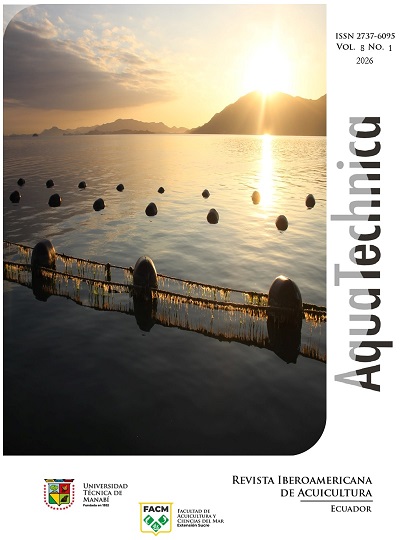
La ostra del Pacífico, Magallana gigas, se cultiva comercialmente en la costa ecuatoriana desde 2014, pero se conoce poco sobre su cultivo en los diferentes ambientes apropiados en la provincia de Manabí. En este estudio se evalúan el crecimiento y la supervivencia de la especie a diferentes densidades de siembra durante las etapas iniciales del cultivo, utilizando un sistema suspendido en palangre. El estudio se realizó en el muelle pesquero de San Mateo, cantón Manta, Ecuador, entre septiembre y diciembre 2023. Se sembraron las ostras en tres densidades, 100 (DOMIN), 200 (DOMED) y 300 (DOMAX) con tres réplicas. Se colocaron dentro de recipientes de PE con diámetro 26 cm y altura 9 cm, con poros de 2 mm2, dispuestos aleatoriamente en linternas chinas de 3 niveles de 40 cm de diámetro. Se registró semanalmente la temperatura, salinidad, pH y turbidez (Secchi) del agua en la zona de cultivo. La longitud dorso-ventral (LDV) inicial fue 0,86±0,24 cm y el peso 0,23±0,22 g. La temperatura varió entre 28,9°C y 27,3 °C; la salinidad entre 34 y 35 ppm; el pH entre 7,6 y 7,83 y la profundidad de Secchi entre 1,7 y 2,1 m. A los 63 días de cultivo, las LDV y pesos totales promedio fueron 2,13±0,89 cm y 1,33±1,29 g (DOMIN), 1,81±0,79 cm y 0,95±0,94 g (DOMED) y 1,73±0,73 cm y 0,82±0,83 g (DOMAX), difiriendo solo los valores de DOMIN de las otras dos densidades. Las tasas de supervivencia observadas fueron 75% (DOMIN), 69% (DOMED) y 65% (DOMAX), sin diferencia significativa entre densidades. Las bandejas rígidas fueron colonizadas externamente por comunidades incrustantes, pero no así las ostras contenidas en ellas que se mantuvieron limpias. Se recomienda que el cultivo de M. gigas, se efectúe a una densidad de 100 ostras por contenedor de 26 cm de diámetro, para obtener la mayor tasa de crecimiento.
Descargas
Citas
Baghurst B., Mitchell J. G. (2002). Sex-specific growth and condition of the Pacific oyster (Crassostrea gigas Thunberg). Aquaculture Research 33(15):1253 – 1263. https://doi.org/10.1046/j.1365-2109.2002.00788.x
Barraza-Guardado R. H., Chavez-Villalba J., Atilano-Silva H., Hoyos-Chairez F. (2009). Seasonal variation in the condition index of Pacific oyster postlarvae (Crassostrea gigas) in a land-based nursery in Sonora, Mexico. Aquaculture Research 40:118-128. https://doi.org/10.1111/j.1365-2109.2008.02076.x
Basurto-Aguirre A. (2017). Estudio de pre-factibilidad para implementar un cultivo de ostras (Crassostrea gigas) en fase de engorde. Tesis de pregrado. Universidad Técnica de Manabí, Facultad de Ciencias Veterinarias, Escuela de Ingeniería en Acuicultura y Pesquerías.
Chávez-Villalba J., Alfredo Arreola-Lizárraga A., Burrola-Sánchez S., Hoyos-Chairez F. (2010). Growth, condition, and survival of the Pacific oyster Crassostrea gigas cultivated within and outside a subtropical lagoon. Aquaculture 300(1-4):128-136. https://doi.org/10.1016/j.aquaculture.2010.01.012
FAO. (2024). El estado mundial de la pesca y la acuicultura. La transformación azul en acción. Roma. https://doi.org/10.4060/cd0683es.
FAO. (2020). Estadísticas de Pesca y Acuicultura. Producción global 1950-2018 (Paneles de consulta en línea). Departamento de Pesca y Acuicultura de la FAO, Roma.
Gagnaire B., Frouin H., Moreau K., Thomas-Guyon H., Renault T. (2006). Effects of temperature and salinity on haemocyte activities of the Pacific oyster, Crassostrea gigas (Thunberg). Fish and Shellfish Immunology 20(4):536-47. https://doi.org/10.1016/j.fsi.2005.07.003.
Honkoop P., Bayne B. (2002). Stocking density and growth of the Pacific oyster (Crassostrea gigas) and the Sydney rock oyster (Saccostrea glomerata) in Port Stephens, Australia Aquaculture 213:171-186. https://doi.org/10.1016/S0044-8486(02)00030-3
Johnson R. W. (1978). Mapping of chlorophyll a distributions in coastal zones. Photogrammetric Engineering and Remote Sensing 44. https://ntrs.nasa.gov/search.jsp?R=19780052739
Liu H., Ye T., Soon T. K., Zhang H., Cheng D., Li S., ... Zheng H. (2019). Effects of stocking density on the growth performance, bacterial load and antioxidant response systems of noble scallop Chlamys nobilis. Fish and Shellfish Immunology 92:40-44. https://doi.org/10.1016/j.fsi.2019.05.053
Lacoste E., Gaertner‐Mazouni N. (2014). Biofouling impact on production and ecosystem functioning: a review for bivalve aquaculture. Reviews in Aquaculture 7(3):187-196. https://doi.org/10.1111/raq.12063
Lodeiros C., Galindo L., Buitrago E., Himmelman J. (2007). Effects of mass and position of artificial fouling added to the upper valve of the mangrove oyster Crassostrea rhizophorae on its growth and survival. Aquaculture 262(1):168-171. https://doi.org/10.1016/j.aquaculture.2006.10.002
Lodeiros C., Himmelman J. (1996). Influence of fouling on the growth and survival of the tropical scallop, Euvola (Pecten) ziczac (L. 1758) in suspended culture. Aquaculture Research 27(10):749-756.
Lodeiros C., Rodríguez-Pesantes D., Márquez A., Revilla J., Chávez Villalba J. Sonnenholzner S. (2018). Suspended culture of the Pacific oyster Crassostrea gigas in the tropical eastern Pacific. Aquaculture Internactional 26:337–347. https://doi.org/10.1007/s10499-017-0217-z
Lodeiros, C., Valentich-Scott, P., Chávez-Villalba, J., Mazón-Suástegui, J. M., & Grijalva-Chon, J. M. (2020). Tropical and subtropical Ostreidae of the American Pacific: taxonomy, biology, ecology, and genetics. Journal of Shellfish Research 39(2), 181-206. https://doi.org/10.2983/035.039.0202
Loján-Avellán M., Zapata-Vívenes E., Treviño L. M., Lodeiros C. (2021). Biomarcadores celulares e inmunológicos en la ostra del Pacífico Crassostrea gigas (Thunberg, 1793). La Técnica. Edición especial:52-68. https://doi.org/10.33936/la_tecnica.v0i0.3065
Mann R., Burreson E. M., Baker P. K. (1991). The decline of the Virginia oyster fishery in Chesapeake Bay: Considerations for introduction of a non-endemic species, Crassostrea gigas (Thunberg, 1793). Journal of Shellfish Research 10(2): 379-388.
Mercer M., Gennari L., Lovatelli A. (2024). Pacific oyster farming – A practical manual. FAO Fisheries and Aquaculture Technical Papers, No. 696. FAO, Rome. https://doi.org/10.4060/cc9396en
Miyazaki I. (1938). On fouling organisms in the oyster farm. Nippon Suisan Gakkaishi 6(5):223-232. https://doi.org/10.2331/suisan.6.223
Ngo T., Kang S-G, Kang D-H, Sorgeloos P., Choi K-S (2006). Effect of culture depth on the proximate composition and reproduction of the Pacific oyster, Crassostrea gigas from Gosung Bay, Korea. Aquaculture 253:712–720. https://doi.org/10.1016/j.aquaculture.2005.09.009
Nuñez M. P., Lodeiros C., Ramirez E., Narváez N., Graziani C. (2010). Crecimiento y sobrevivencia de la ostra de mangle Crassostrea rhizophorae bajo condición de cultivo intermareal y submareal. Zootecnia Trop. 28(2): 239-254.
Peterson C.H., Beal B. F. (1989). Bivalve Growth and Higher Order Interactions: Importance of Density, Site, and Time. Ecology 70(5):1390-1404. http://www.jstor.org/stable/1938198 .
Petraitis P. S. (1995). The role of growth in maintaining spatial dominance by mussels (Mytilus edulis). Ecology 76(4):1337-1346. http://www.jstor.org/stable/1940940
Picardo A., Álvarez I., Vaz N., Diaz J. M. (2013). Chlorophyll concentration along the northwestern coast of the Iberian Peninsula vs. atmosphere-ocean-land conditions. J. of Coastal Research 65(2):2047-2052. https://doi.org/10.2112/SI65-346.1
Pouvreau S., Bourles Y., Lefebvre S., Gangnery A., Alunno-Bruscia M. (2006). Application of a dynamic energy budget model to the Pacific oyster, Crassostrea gigas, reared under various environmental conditions. J. Sea. Res. 56(2):156–167. https://doi.org/10.1016/j.seares.2006.03.007
Rivera Mendoza M.A. (2023). Cultivo de la ostra del Pacífico Magallana gigas (Thumberg, 1793) a distintas profundidades en Jaramijó, Manabí, Ecuador. Tesis de pregrado. Universidad Laica Eloy Alfaro de Manabí, Manta, Ecuador.
Rodríguez Ponce H. M. (2015). Evaluación del crecimiento y la supervivencia de Crassostrea gigas (Thunberg, 1793), bajo condiciones de cultivo suspendido en mar abierto, en la comuna Palmar, Santa Elena – Ecuador. Tesis de pregrado. Universidad Estatal Península de Santa Elena, Ecuador. https://repositorio.upse.edu.ec/handle/46000/2181
Rodríguez-Quiroz G., García-Ulloa M., Domínguez-Orozco A. L., Valenzuela-Hernández T. N., Nava-Pérez E., Góngora-Gómez A. M. (2016). Relación del crecimiento, condición y supervivencia del ostión del Pacífico Crassostrea gigas y las variables ambientales, cultivado en suspensión en el sistema lagunar Navachiste-Macapule, Sinaloa, México. Revista de Biología Marina y Oceanografía 51(3): 541-551. https://doi.org/10.4067/S0718-19572016000300006
Runetto L.J., Gomes C., Araujo de Miranda Gomes C., de Oliveira Ramos C., da Silva F.C., Ramos Ferreira J., Cleusa G., Rodríguez C. (2020).). The effect of density on the cultivation of the native mangrove oyster Crassostrea tulipa (Lamarck, 1819). Latin American Journal of Aquatic Research 48(5):855-868. https://doi.org/10.3856/vol48-issue5-fulltext-2446
Sakamaki T., Hatakeyama Y., Saito H., Fujibayashi M., Hayashi S., Filgueira R. (2025). Benefits from removing fouling mussels in suspension oyster aquaculture: An evaluation using farm-scale carbon budget and bivalve growth models. Aquaculture 605:742531. https://doi.org/10.1016/j.aquaculture.2025.742531
Treviño L., Lodeiros C., Vélez‐Falcones J., Chávez‐Alcivar C., Isea‐León F., Bermúdez‐Medranda A., Vélez-Chica J. C., Cruz-Quintana Y., Leal D., Santana-Piñeros A.M., Rodríguez‐Pesantes D. (2020). Suspended culture evaluation of Pacific oyster Crassostrea gigas in a tropical estuary. Aquaculture Research 51(5):2052-2061. https://doi.org/10.1111/are.14556
ULEAM (2016). Normativa de ética en procesos de investigación científica. Universidad Laica Eloy Alfaro de Manabí, Manta, Ecuador. https://www.uleam.edu.ec/wp-content/uploads/2016/10/Normativa-Institucional-de-etica.pdf
Vásquez H. E., Pérez Rosales R. J., Pacheco Reyes S. P., Kani K. (2007). Guía para el cultivo de Ostra del Pacífico (Crassostrea gigas). JICA, CENDEPESCA, El Salvador. https://www.jica.go.jp/Resource/project/elsalvador/2271029E1/materials/pdf/2007/2007_04.pdf
Velez Falcones J. E., Treviño Zambrano L. M., Vélez Chica J. C., Lodeiros C. (2024). Stocking density of Magallana gigas under suspended culture conditions in a tropical estuary. J App Aquac 37(4):344-357. https://doi.org/10.1080/10454438.2024.2430971
Publicado
Número
Sección
Licencia
Derechos de autor 2026 Carlos Suarez Morrillo, Gavrik Larrea Ycaza, Jose Javier Alio MIngo

Esta obra está bajo una licencia internacional Creative Commons Atribución-NoComercial-CompartirIgual 4.0.